


Image not available
Metals & minerals
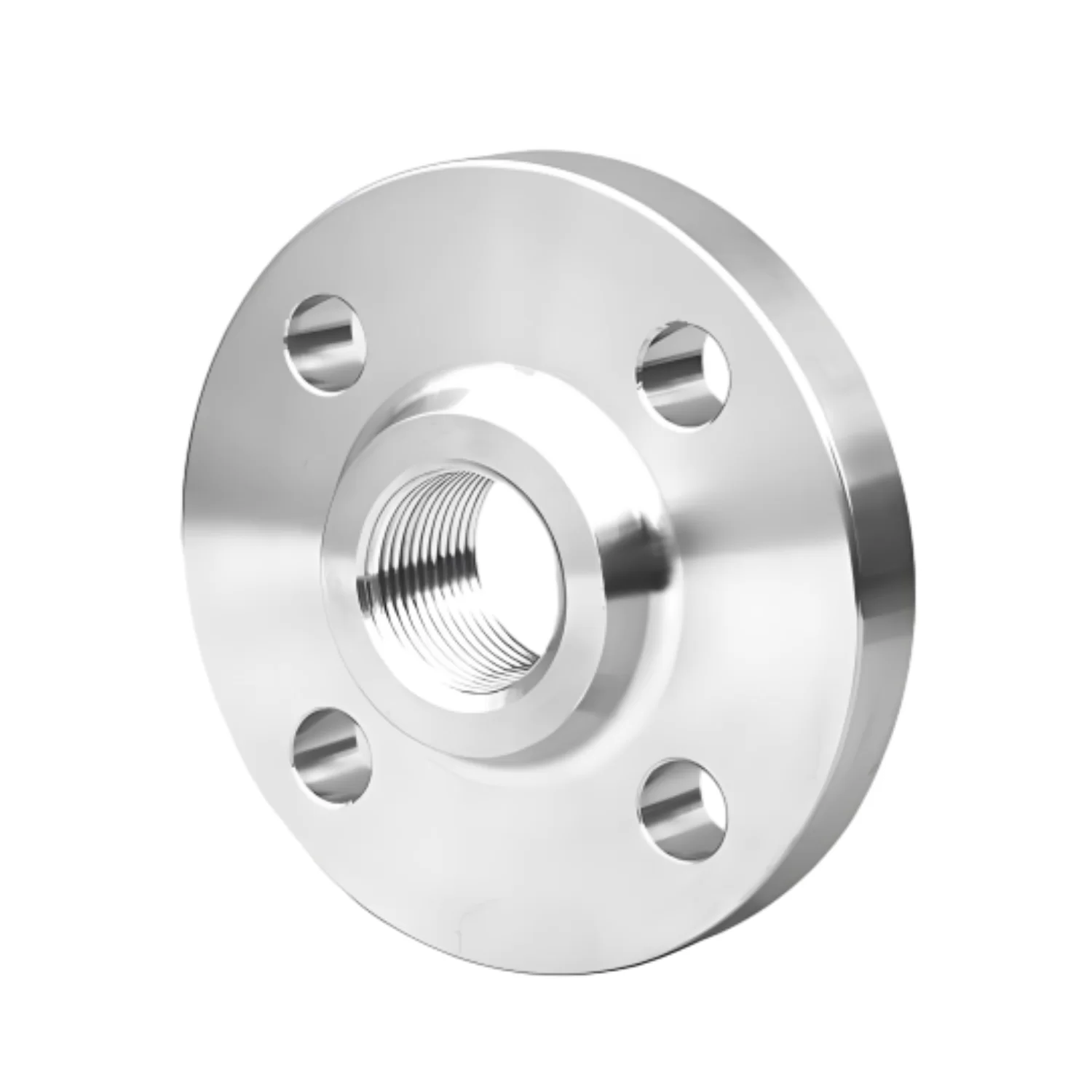
Threaded Flange
<p>A threaded flange (ASME B16.5 Threaded Flange) is a pipe fitting that achieves connection by screwing the internal thread of the flange with the external thread of the pipe, requiring no welding. It is widely used in pipeline systems with moderate pressure ratings that demand frequent disassembly or maintenance. Composed of a flange disc, sealing face, threaded bore, and connecting bolt holes, it features easy in…
SupplierCangzhou Weihuan Pipeline Equipment Co.,Ltd.www.weihuantube.com
Source categories
About this product
Product information from the supplier.
I. Product Overview
A threaded flange (ASME B16.5 Threaded Flange) is a pipe fitting that achieves connection by screwing the internal thread of the flange with the external thread of the pipe, requiring no welding. It is widely used in pipeline systems with moderate pressure ratings that demand frequent disassembly or maintenance. Composed of a flange disc, sealing face, threaded bore, and connecting bolt holes, it features easy installation, reliable sealing, and cost-effectiveness, making it suitable for transporting various media such as water, oil, and gas.
II. Executive Standards
1. Design Standard: Complies with ASME B16.5 Pipe Flanges and Flanged Fittings, covering pressure ratings (Class 150, 300, 600, 900, 1500, 2500), size range (1/2" to 24", with some specifications up to 48"), and material requirements.
2. Thread Standard: Internal threads typically adopt NPT (National Pipe Tapered Thread) with a taper of 1:16, ensuring sealing through thread profile after screwing. For some low-pressure scenarios, NPSM (National Pipe Straight Mechanical) threads can be used with gaskets.
3. Material Standard: Common materials include carbon steel (A105, A350 LF2), stainless steel (304, 316, 321), and alloy steel (F11, F22). Material selection should be based on media characteristics (corrosiveness, temperature, pressure) and operating conditions, with material performance complying with relevant ASTM or ASME specifications.
III. Structural Features
1. Threaded Connection Design: The flange bore is processed with continuous tapered or straight threads, which directly screw into the external threads of the pipe. This eliminates the need for welding, avoiding the impact of high welding temperatures on pipe material—especially suitable for thin-walled pipes or non-ferrous metal pipes.
2. Sealing Face Types: Depending on pressure ratings and sealing requirements, sealing faces can be Raised Face (RF), Flat Face (FF), Male-Female Face (MFM), etc., with RF being the most commonly used.
3. Flange Disc & Bolt Holes: The outer diameter of the flange disc, as well as the number and diameter of bolt holes, strictly adhere to ASME B16.5 specifications to ensure interchangeability with flange covers, valves, and other fittings of the same standard. Bolt holes are symmetrically distributed in a circular pattern to facilitate uniform force tightening and prevent sealing face deformation.
IV. Technical Parameters
Item | Technical Indicators |
Pressure Rating | Class 150 (PN2.0MPa) to Class 2500 (PN42.0MPa). The specific rated pressure decreases with increasing temperature (refer to ASME B16.5 Pressure-Temperature Rating Tables). |
Applicable Temperature Range | -29℃ to +650℃ (depending on material: e.g., carbon steel ≤425℃, stainless steel ≤600℃, alloy steel can withstand higher temperatures). |
Nominal Diameter (DN/NPS) | 1/2" (DN15) to 24" (DN600); custom special specifications available. |
Thread Precision | Complies with ANSI/ASME B1.20.1 (for NPT threads) or B1.20.3 (for NPSM threads), with a thread profile angle of 60°. |
Surface Treatment | Carbon steel flanges typically undergo galvanization (hot-dip galvanization/electrogalvanization) or painting for rust prevention; stainless steel flanges can be pickled and passivated or mirror-polished. |
V. Application Scenarios
1. Industrial Pipeline Systems: In industries such as petroleum, chemical engineering, power generation, and water treatment, it is used for pipe branches and valve connections that require regular maintenance (non-high temperature and high pressure), such as instrumentation pipelines, sampling pipelines, and temporary pipelines.
2. Construction & Civilian Fields: HVAC (Heating, Ventilation, and Air Conditioning), fire protection pipelines, and gas transmission. Its easy installation makes it suitable for on-site rapid construction and later maintenance/renovation.
3. Special Operating Conditions: Not applicable to scenarios with severe vibration or frequent displacement (threads may loosen), nor recommended for highly corrosive media (corrosion-resistant materials and sealing measures are required). For high-pressure conditions (Class 900 and above), strict control of thread machining precision and tightening torque is necessary.
VI. Advantages & Limitations
Advantages
●No welding equipment required for installation, ensuring high construction efficiency.
●Easy disassembly, facilitating maintenance and replacement.
●Strong adaptability to pipe materials, reducing the risk of welding defects.
Limitations
●Sealing reliability is significantly affected by thread machining precision and installation techniques; not suitable for high-pressure (above Class 2500) or cyclic load conditions.
●Threaded joints have poor vibration resistance—additional supports or threaded flanges with stop devices should be used in vibrating environments.
With these characteristics, threaded flanges, due to their flexibility and cost-effectiveness, are an ideal choice for pipe connections in small-to-medium diameters and non-extreme operating conditions, widely serving global industrial and civilian pipeline systems.
What Is a Threaded Flange and When Should You Use It?
Threaded flanges, also known as screwed flanges, are designed with internal pipe threads that allow them to connect directly to threaded pipes without welding. Unlike weld neck or slip-on flanges, threaded flanges can be installed quickly using threaded connections, making them ideal for applications where welding is impractical, hazardous, or prohibited.
One of the biggest advantages of a threaded flange is simplified installation. Since no welding equipment is required, installation time is significantly reduced, and maintenance becomes easier because the flange can be removed without cutting the pipeline. This feature makes threaded flanges particularly suitable for low-pressure systems, hazardous locations, and facilities where hot work permits are difficult to obtain.
Threaded flanges are commonly used in fire protection systems, compressed air pipelines, water treatment plants, fuel systems, hydraulic installations, and small-diameter process piping. Stainless steel threaded flanges are preferred for corrosive environments, while carbon steel threaded flanges offer excellent strength and cost efficiency for general industrial service.
At Weihuan, threaded flanges are manufactured according to ASME B16.5, ANSI, DIN, EN, and JIS standards, ensuring reliable sealing performance, accurate threading, and compatibility with international piping systems.
Threaded Flange Types: Choosing the Right Connection
Although all threaded flanges share the same threaded connection principle, they are available in different materials, pressure ratings, sealing faces, and standards to meet various industrial applications.
Raised Face (RF) threaded flanges are the most widely used because they provide improved gasket compression and sealing performance in medium-pressure systems. Flat Face (FF) threaded flanges are typically selected for low-pressure water systems where flat mating surfaces are required. Ring Type Joint (RTJ) threaded flanges are less common but can be specified for higher-pressure applications requiring metal-to-metal sealing.
Material selection is equally important. Carbon steel threaded flanges provide high strength and economical performance for oil, gas, steam, and industrial utilities. Stainless steel threaded flanges offer excellent corrosion resistance, making them suitable for chemical processing, food production, pharmaceutical facilities, and marine engineering. Alloy steel threaded flanges are available for elevated temperature and pressure environments.
When selecting threaded flange types, engineers should evaluate operating pressure, fluid characteristics, corrosion resistance, temperature range, applicable piping standards, and maintenance requirements. Choosing the appropriate flange design ensures reliable performance and long service life.
Threaded Flange vs Slip-On Flange: Which Is Better?
Threaded flanges and slip-on flanges are both popular choices for connecting pipelines, but they differ significantly in installation methods and application scenarios.
A threaded flange uses internal threads to connect directly to threaded pipe without welding, making installation simple and fast. In contrast, a slip-on flange slides over the pipe and requires fillet welding on both sides to achieve structural strength and leak-tight sealing.
Threaded flanges are best suited for low-pressure, small-diameter piping systems where welding is difficult or unsafe. They are widely used in hazardous areas, temporary installations, and maintenance-friendly piping networks. Slip-on flanges, however, are better suited for medium-pressure industrial pipelines requiring greater mechanical strength and vibration resistance.
Cost is another consideration. Although threaded flanges eliminate welding costs, threaded piping preparation may increase machining expenses. Slip-on flanges generally offer lower flange costs but require additional welding labor and inspection.
For projects prioritizing easy installation and future maintenance, threaded flanges provide a practical solution. For higher-pressure systems subjected to vibration or cyclic loading, slip-on or weld neck flanges are generally preferred.
Threaded Flange vs Socket Weld Flange
Threaded flanges and socket weld flanges are frequently compared because both are commonly used in small-diameter piping systems. However, their connection methods and performance characteristics are quite different.
A threaded flange relies entirely on threaded pipe connections, allowing installation without welding. This makes it ideal for explosive environments, maintenance work, and applications where hot work must be avoided.
Socket weld flanges feature a recessed socket that receives the pipe before being fillet welded externally. This design provides greater mechanical strength and fatigue resistance while maintaining smooth internal flow characteristics.
Threaded flanges are generally recommended for lower-pressure services and non-cyclic operating conditions. Socket weld flanges perform better under high pressure, temperature fluctuations, and vibration because welded joints provide stronger structural integrity.
The choice ultimately depends on system requirements, installation conditions, maintenance accessibility, and operating pressure.
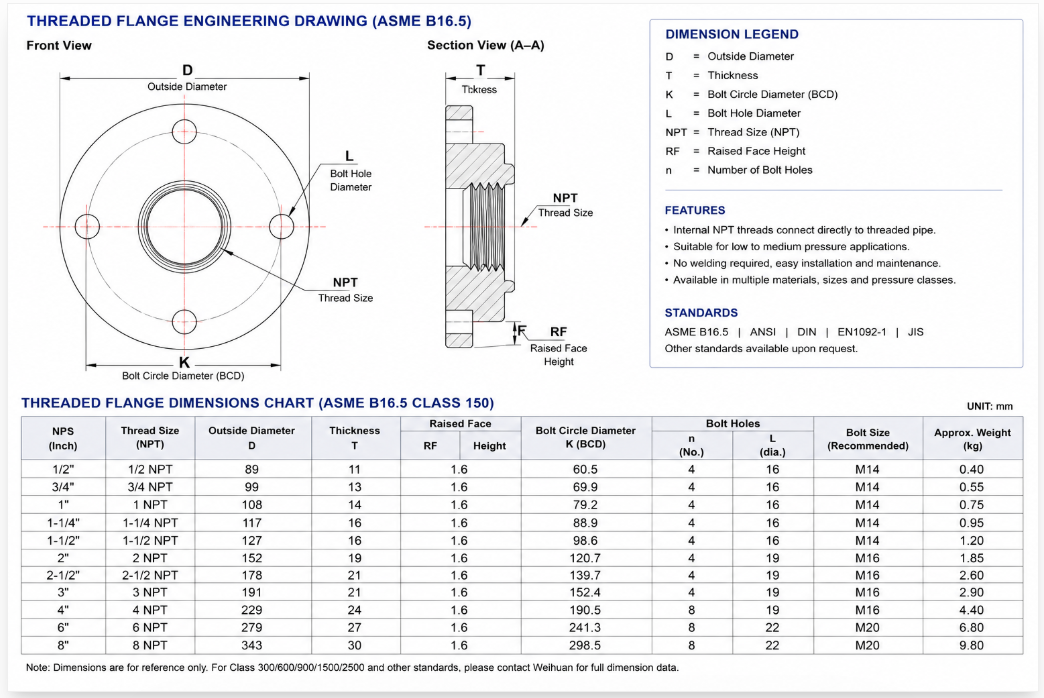
Threaded Flange Dimensions Chart
| NPS | Thread Size | Outside Diameter | Thickness | Bolt Circle | Bolt Holes |
|---|---|---|---|---|---|
| 1/2" | 1/2 NPT | 89mm | 11mm | 60.5mm | 4 |
| 3/4" | 3/4 NPT | 99mm | 13mm | 69.9mm | 4 |
| 1" | 1 NPT | 108mm | 14mm | 79.2mm | 4 |
| 2" | 2 NPT | 152mm | 19mm | 120.7mm | 4 |
| 3" | 3 NPT | 191mm | 21mm | 152.4mm | 4 |
| 4" | 4 NPT | 229mm | 24mm | 190.5mm | 8 |
| 6" | 6 NPT | 279mm | 27mm | 241.3mm | 8 |
D = Outside Diameter
T = Thickness
K = Bolt Circle Diameter
L = Bolt Hole Diameter
NPT Thread Size
Pressure Class
Why Choose Weihuan as Your Threaded Flange Supplier?
Selecting a reliable threaded flange supplier is essential for ensuring product quality, dimensional accuracy, and dependable project delivery. At Weihuan, we specialize in manufacturing threaded flanges for global industrial markets, offering products that comply with ASME B16.5, ANSI, DIN, EN, and JIS standards.
Our production capabilities include stainless steel, carbon steel, alloy steel, and customized threaded flanges with a wide range of pressure classes, face types, and thread specifications. Every flange undergoes strict dimensional inspection, material verification, and quality testing to ensure consistent sealing performance and full compatibility with international piping systems.
Whether you require standard products or customized OEM solutions, Weihuan provides technical support from material selection to engineering drawings and production. With competitive pricing, stable manufacturing capacity, and worldwide export experience, we help distributors, EPC contractors, and industrial equipment manufacturers source reliable threaded flanges efficiently.
If you are looking for threaded flange manufacturers, a trusted threaded flange supplier, or threaded flanges for sale, Weihuan offers high-quality products backed by professional engineering expertise and responsive customer service.
Threaded Flange FAQs
What is a threaded flange?
A threaded flange, also known as a screwed flange, is a pipe flange with internal threads that connect directly to threaded pipes without welding. It is commonly used in low- to medium-pressure piping systems where welding is not practical or permitted. Threaded flanges are widely applied in water treatment, fire protection, compressed air, hydraulic systems, and chemical processing because they are easy to install, remove, and maintain.
What are the advantages of a threaded flange?
The primary advantage of a threaded flange is that it eliminates the need for welding, reducing installation time and labor costs. It can be installed in hazardous environments where hot work is restricted and allows easy disassembly for maintenance or system modifications. Threaded flanges also help minimize downtime during equipment replacement. They are especially suitable for small-diameter pipelines operating under moderate pressure and temperature conditions.
What materials are available for threaded flanges?
Threaded flanges are manufactured in a variety of materials to suit different operating environments. Common options include carbon steel, stainless steel (304, 304L, 316, 316L), alloy steel, duplex stainless steel, and nickel alloys. Carbon steel threaded flanges are widely used for general industrial applications, while stainless steel threaded flanges offer superior corrosion resistance for chemical, food processing, marine, and pharmaceutical industries.
What standards do threaded flanges comply with?
High-quality threaded flanges are manufactured according to internationally recognized standards such as ASME B16.5, ANSI, DIN, EN 1092-1, JIS, and BS. These standards specify flange dimensions, pressure ratings, bolt patterns, facing types, and threading requirements to ensure compatibility with piping systems worldwide.
What pressure ratings are available for threaded flanges?
Threaded flanges are commonly available in ASME pressure classes including Class 150, Class 300, Class 600, Class 900, Class 1500, and Class 2500. However, threaded connections are generally recommended for low- to medium-pressure applications. The appropriate pressure class should be selected based on operating pressure, temperature, fluid type, and applicable engineering standards.
How do I choose the right threaded flange?
When selecting a threaded flange, consider the pipe size, thread specification (such as NPT or BSP), pressure class, material, sealing face, operating temperature, and media compatibility. Choosing the correct flange ensures reliable sealing, long service life, and full compatibility with the existing piping system. Consulting an experienced threaded flange manufacturer can help identify the best solution for your application.
What is the difference between a threaded flange and a slip-on flange?
A threaded flange connects to a pipe using internal threads and does not require welding, making installation faster and safer in certain environments. A slip-on flange, by contrast, slides over the pipe and must be welded on both sides to achieve structural strength. Threaded flanges are ideal for maintenance-friendly and low-pressure systems, while slip-on flanges are better suited for higher-pressure industrial applications.
What is the difference between a threaded flange and a socket weld flange?
A threaded flange uses threaded connections, while a socket weld flange requires the pipe to be inserted into a socket and fillet welded. Socket weld flanges provide higher mechanical strength and are recommended for high-pressure or cyclic service. Threaded flanges are preferred where welding is not allowed or where frequent disassembly is required for maintenance.
Can threaded flanges be used for high-pressure applications?
Although threaded flanges are available in high pressure classes, they are generally recommended for low- to medium-pressure piping systems. Under extremely high pressure, elevated temperatures, or severe vibration, welded flange types such as weld neck or socket weld flanges usually provide better structural integrity and long-term reliability. Engineers should always follow applicable piping codes when selecting a flange type.
Why choose Weihuan as your threaded flange manufacturer and supplier?
Weihuan is a professional threaded flange manufacturer and supplier providing carbon steel, stainless steel, and alloy steel threaded flanges for customers worldwide. Our products comply with ASME, ANSI, DIN, EN, and JIS standards and are available in multiple pressure classes, sizes, and facing types. We also offer OEM and customized manufacturing, strict quality control, competitive pricing, and reliable global delivery. Whether you are looking for a single threaded flange or bulk procurement, Weihuan can provide dependable solutions tailored to your project requirements.
More from this supplier
Cangzhou Weihuan Pipeline Equipment Co.,Ltd.


