

Image not available
Industrial manufacturing
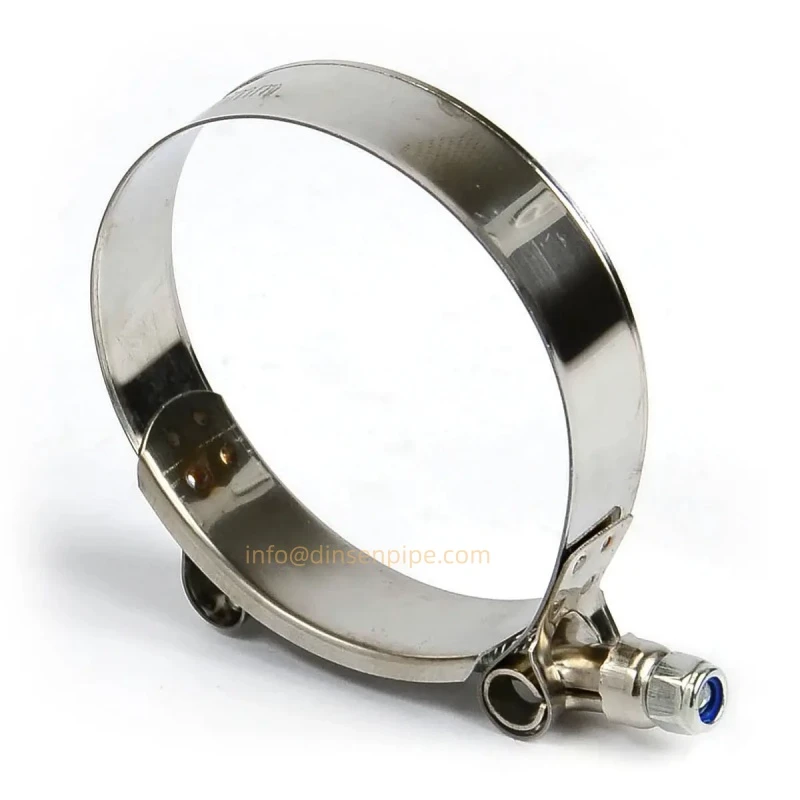
T Bolt Hose Clamp
Why the T-bolt clamp is the standard choice for boosted intake and exhaust joints — with sizing, band width, self-locking nut and torque answers you can spec from.
SupplierDINSEN METAL CO.,LTDwww.dinsenclamps.com
Source categories
About this product
Product information from the supplier.
T Bolt Hose Clamp
- Pressure Rating: 0.8–2.0 MPaBand Width:12–20 mmMaximum Torque: Up to 14.6 N·mLocking: Self-locking nutMaterial AISI 304 / 316 (W4/W5)Temperature: -50°C to 300°CSizing Range Hose OD: 17–130 mm
Why Turbo & Intercooler Joints Need a T-Bolt Clamp
Every boosted engine creates conditions that defeat ordinary clamps:
Pressure: a turbo system typically runs 15–30 PSI (0.1–0.2 MPa) of boost, with spikes over 40 PSI in performance builds — and the joint must hold with a safety margin far above the working pressure. A worm gear clamp is only rated below 1.0 MPa.
Vibration: engine and road vibration slowly backs a worm-drive screw off. A T-bolt's self-locking nut keeps its preload without periodic re-tightening.
Heat cycling: charge-air and exhaust joints swing through hundreds of degrees, causing hose and clamp materials to expand and relax. The bolt-and-nut design maintains tension through the cycle.
Soft hoses: silicone and thin rubber cold-flow and deform under point loads. Only a wide solid band spreads the force evenly around the full 360°.
Design: What Makes the T-Bolt Hold Pressure
Three features separate a T-bolt hose clamp from a worm gear clamp:
T-shaped bolt + self-locking nut. The T-bolt engages a rigid housing; the nut carries the full clamping load on real threads (not on a thin slotted band), so you can apply far higher torque — up to 14.6 N·m without thread stripping. The locking feature stops the nut backing off under vibration.
Wide, thick solid band (12–20mm). An unperforated band distributes clamping force uniformly over the whole hose circumference, eliminating the point loads that cut into silicone and rubber.
360° uniform compression. Because the bridge pulls both band ends evenly, the clamp stays round under torque — no pinch point at the screw, no localized stress concentration.
Pressure Ratings: T-Bolt vs Worm Gear Clamp
| Specification | T-Bolt Clamp | Worm Gear Clamp |
|---|---|---|
| Maximum Torque | Up to 14.6 N·m | Up to 5.6 N·m |
| Pressure Rating | 0.8–2.0 MPa; heavy-duty > 2.0 MPa | Below 1.0 MPa (up to ~150 PSI) |
| Band Width | 12–20 mm (heavy duty) | 8–12 mm (standard) |
| Vibration Resistance | Excellent — self-locking nut | Moderate — may require re-tightening |
| Force Distribution | 360° uniform (solid band) | Localized at screw mechanism |
| Typical Material | AISI 304 / 316 stainless (W4/W5) | AISI 304 / galvanized carbon steel (W1/W2) |
| Best For | High-pressure, high-vibration joints | Low-pressure, general-purpose |
Sizing & Band Width Selection (Hose OD 17–130mm)
| Clamping Range (Hose OD) | Band Width | Typical Application |
|---|---|---|
| 17–32 mm | 12 mm | Small boost lines, sensor and vacuum connections |
| 33–50 mm | 12–14 mm | Compact intercooler pipes, coolant lines |
| 51–76 mm | 16 mm | Turbo inlet, intercooler couplers (the classic t bolt clamp for turbo intercooler sizes) |
| 77–100 mm | 18–20 mm | Charge-air pipes, main exhaust, heavy-duty intake |
| 100–130 mm | 20 mm | Large industrial, truck and marine hoses |
Installation & Torque in 5 Steps
Measure, then verify the range. Measure hose OD with fittings installed (add 1–2mm for bead expansion if measuring off-vehicle) and confirm it falls in the middle third of the clamp range.
Position the clamp. Center the band over the bead or hose end so the housing sits where it will not foul adjacent parts, and orient the T-bolt for tool access.
Pre-tighten by hand. Run the self-locking nut down until the band is snug and the clamp is round — check the band has not pinched the hose.
Tighten with a torque wrench in two passes. Use a reference of 6–12 N·m depending on size (see table), tighten once, let the joint settle, then re-torque to the same value. DINSEN T-bolts are engineered to an ultimate torque up to 14.6 N·m.
Verify under boost. Run the system, listen for hiss at the joint, and re-check torque after the first thermal cycle.
FAQ
1. What size t bolt clamp do I need for a turbo or intercooler hose?
Measure the outside diameter of the hose with the pipe or bead fitting installed — a bead can add 1–2mm to the OD. T-bolt clamps have a narrow adjustment range, so your measured OD must sit inside that range, ideally in the middle third. Typical turbo and intercooler couplers fall between 51mm and 76mm OD, which suits a 16mm band T-bolt clamp.
2. What is the pressure rating of a t bolt hose clamp?
DINSEN T-bolt clamps are rated for 0.8–2.0 MPa (2.0 MPa ≈ 290 PSI), with heavy-duty variants exceeding 2.0 MPa. That rating covers boosted intake systems, charge-air pipes and hydraulic lines where worm gear clamps (below 1.0 MPa) are not recommended.
More from this supplier
DINSEN METAL CO.,LTD


